

Showing posts with label news. Show all posts
Showing posts with label news. Show all posts
Saturday, 21 January 2012


Friday, 4 November 2011

Friday, 22 July 2011
How the world changed in six short months...
Published by The Day on Friday 22nd July, co-authored with Ferdie Addis.
Click on graphic to enlarge.

Thursday, 21 July 2011
Somali food crisis worsens to official famine
Published by The Day (a newspaper for schools) on Thursday 21st July
Two regions of Somalia were yesterday officially classified as in famine. UNICEF's chief says this story should get more space than the hacking scandal. Is he right?
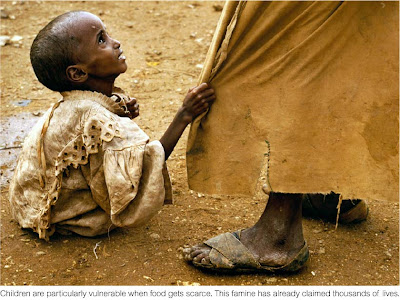
Habiba has travelled to Mogadishu, the capital of Somalia, from a village in the south-west of the country. She walked 200 km. Her five children were walking with her, but the two youngest, aged two and five, died on the way. She says she abandoned their bodies along the roadside because she was too weak to dig them graves.
These are just two of the tens of thousands who have already died in the disaster gripping the Horn of Africa. The crisis was yesterday upgraded to famine status. How has the situation come to this?
Somalia is a country of nine million on the east coast of Africa. For the last two years the rains have failed, causing drought. This is in part due to normal weather patterns, but may have been made worse by climate change.
But that isn't the whole story. Somalia is a political mess. It has not had an effective national government in 20 years – instead the country is controlled by various armed groups. Islamist Al Shabaab controls much of the country's south, and is defined by the US as a terrorist group.
The group ordered all aid workers out of the country in 2009, labelling them 'infidels.' In spite of recently announcing they will let aid in, Al Shabaab's intentions are unclear. In the past they have 'taxed' aid, essentially stealing it, have refused to allow female or foreign relief workers, and are currently threatening those programmes they believe to be favouring other factions.
Al Shabaab's presence means the US has slashed aid to Somalia for fear of funding terrorists. Oxfam has called some EU states' slow response 'wilful neglect'. A UK pledge of £90 million in food aid, and private donations of £20 million are not enough.
UK concern for the famine may have been low due to lack of media coverage: UNICEF yesterday took out full page newspaper advertisements asking readers to 'move the news agenda on' from the tabloid phone hacking scandal dominating the British media onto 'another, far bigger and vital story'.
Neglect and apathy
Perhaps UNICEF is right. Yesterday's Guardian had 12 pages on the hacking scandal. Is this, a media story about the media, just journalists self-obsessing? Ironically, in focusing on News of the World failing to act correctly, journalists are potentially again neglecting their duties, this time to report what the world needs to know: the first major famine of the 21st Century.
Or perhaps it is unfair of David Bull, the fund's director, to suggest that famine is more newsworthy. While we should care about the thousands dying in Africa, is it natural to be apathetic about a disaster so difficult to relate to and so far from home, when there are dramatic goings on that affect our lives, here on our doorstep?

Two regions of Somalia were yesterday officially classified as in famine. UNICEF's chief says this story should get more space than the hacking scandal. Is he right?

Habiba has travelled to Mogadishu, the capital of Somalia, from a village in the south-west of the country. She walked 200 km. Her five children were walking with her, but the two youngest, aged two and five, died on the way. She says she abandoned their bodies along the roadside because she was too weak to dig them graves.
These are just two of the tens of thousands who have already died in the disaster gripping the Horn of Africa. The crisis was yesterday upgraded to famine status. How has the situation come to this?
Somalia is a country of nine million on the east coast of Africa. For the last two years the rains have failed, causing drought. This is in part due to normal weather patterns, but may have been made worse by climate change.
But that isn't the whole story. Somalia is a political mess. It has not had an effective national government in 20 years – instead the country is controlled by various armed groups. Islamist Al Shabaab controls much of the country's south, and is defined by the US as a terrorist group.
The group ordered all aid workers out of the country in 2009, labelling them 'infidels.' In spite of recently announcing they will let aid in, Al Shabaab's intentions are unclear. In the past they have 'taxed' aid, essentially stealing it, have refused to allow female or foreign relief workers, and are currently threatening those programmes they believe to be favouring other factions.
Al Shabaab's presence means the US has slashed aid to Somalia for fear of funding terrorists. Oxfam has called some EU states' slow response 'wilful neglect'. A UK pledge of £90 million in food aid, and private donations of £20 million are not enough.
UK concern for the famine may have been low due to lack of media coverage: UNICEF yesterday took out full page newspaper advertisements asking readers to 'move the news agenda on' from the tabloid phone hacking scandal dominating the British media onto 'another, far bigger and vital story'.
Neglect and apathy
Perhaps UNICEF is right. Yesterday's Guardian had 12 pages on the hacking scandal. Is this, a media story about the media, just journalists self-obsessing? Ironically, in focusing on News of the World failing to act correctly, journalists are potentially again neglecting their duties, this time to report what the world needs to know: the first major famine of the 21st Century.
Or perhaps it is unfair of David Bull, the fund's director, to suggest that famine is more newsworthy. While we should care about the thousands dying in Africa, is it natural to be apathetic about a disaster so difficult to relate to and so far from home, when there are dramatic goings on that affect our lives, here on our doorstep?
Wednesday, 20 July 2011
US space shuttle returns to Earth for the last time
Published by The Day on Wednesday, 20 July 2011
Atlantis will reach Kennedy Space Station tomorrow morning. Thirty years after the ambitious space shuttle programme began, is the project a triumph or an embarrassment?

Tomorrow marks the end of an era for global space flight, as a NASA space shuttle re-enters Earth's atmosphere for the final time. The Atlantis is due to touch down on the runway at the Kennedy Space Centre at 05:57 local time.
The shuttle left its dock at the International Space Station (ISS) yesterday morning, and is currently orbiting the Earth. On saying their goodbyes the astronauts aboard Atlantis gave two gifts to the ISS crew: a model of the shuttle, to remind them of the role it played in building the space station, and an American flag flown on the first shuttle flight in 1981. This flag will be handed to the next American astronauts to reach the ISS. If the orbiter makes a safe return, it will be put on public display for visitors to the Kennedy Centre.
For 30 years, the six different reusable craft that in turn made up the space shuttle program played a valuable role in colonising space. Carrying supplies to and from space stations, attaching sections to the ISS, repairing satellites and the Hubble Telescope, the ships took space flight from being glamorous and exciting to frequent and reliable.
But the 135 flights were not trouble free. Equipment failures in the Challenger shuttle in 1986 and the Columbia shuttle in 2003 resulted in a total of fourteen deaths.
The extreme danger, coupled with the massive cost of the project led to this month's 12-day flight being the programme's last.
The US's human presence in space has an uncertain future. With no other reusable shuttles, trips to the ISS must now be done using Russian Soyuz rockets. Commercial providers such as Virgin are building the next generation of space craft. These may eventually be contracted by NASA to do US space programme work, but none are expected to even be ready to enter space before 2014.
Science fiction or vanity?
The dream of the space shuttle programme was to make space travel routine and accessible, a necessary stepping stone to the stuff of science fiction: mass human space flight, floating villages, a life on Mars. With Atlantis grounded, this dream is dying.
But is this desire to plant a flag on space an outdated model of exploration? Victorian explorers took great joy in claiming a new land for their country, but perhaps the more important discoveries are not made by setting foot on fresh ground, but in achieving new levels in human understanding. Our resources might be better used answering what is human consciousness, and what is going on deep inside the Earth.
Tuesday, 19 July 2011
Cameron tells Africa 'trade not aid'
Published by The Day on Tuesday, 19 July 2011
Today the Prime Minister is in Nigeria on a trip promoting trade between the UK and Africa. But is buying and selling enough in the face of multiple humanitarian disasters?

As the hacking firestorm blazes on, Prime Minister David Cameron today is trying to draw attention to a more important issue: Africa. On his two-day trip to South Africa and Nigeria, the PM will lay out his radical new plan for the UK's involvement with the world's poorest continent. His message? Trade, not aid.
Once it was 'China', but now 'Africa' is the word on businessmen's lips. EU economies are floundering, the US is shaky, and Asian growth is slowing, but Africa has a huge projected growth of 5.5% next year, with star performer Ghana expecting a China-beating 13.4%. Where there is growth, there are profits to be made.
Cameron is ostensibly in Nigeria today to push the idea of an African free trade area. Commerce not charity, he says, is the way to help Africa, and since only 12% of African trade is with other countries on the continent, making buying and selling within Africa easier is the first step.
But it seems that Britain also wants a slice of the (rapidly growing) pie. The PM travels with Lord Green, the UK trade minister, and 25 British business leaders, and valuable introductions are being made.
The opportunity for growth and profits in Africa is unprecedented for four key reasons. First, progress in health and education means there is an able workforce and more consumers. Second, a young population means this workforce is massive. Third, governments are becoming more transparent and democratic, providing a stable environment for trade.
And fourth, a few trailblazing technologies like mobile phones have demonstrated how successful investing in Africa can be.
Foreign direct investment (FDI) is key to economic development, and whilst Africa only sees under 5% of the world's FDI, that's an 80% increase on 10 years ago. The World Bank says 'Africa could be on the brink of an economic takeoff, much like China was 30 years ago'. Africa, the cradle of humanity, represents our history, and now it may also be our future.
Ridiculous or riches?
As drought threatens 4.5 million lives in East Africa, wars rage across the continent, and over 23 million in sub-Saharan Africa are living (and dying) with HIV, suggesting trade as the answer seems ridiculous. What might be a route for Ghana or Nigeria is useless to the thirsty, the dead and the dying of Somalia, Zimbabwe and Zambia.
But for Africa's less troubled states increased trade could be miraculous, creating a sustainable escape route from poverty. An African free trade area could increase GDP by $62 billion a year, $20 billion more than current world aid to sub-Saharan Africa. Not only is this great news for Africa, but the more they trade with the outside world, the better it is for everyone else too.
Monday, 18 July 2011
Internet guru attacks Google’s ‘toxic wasteland’
Published by The Day on Monday, 18 July 2011
Google is king of the internet. It's so powerful, says a new theory, that not only can it answer almost any question, it can make you boring and stupid in the process.

It is one of the biggest companies on the planet and one that millions have come to depend on. But it is under attack. And this weekend a new missile has been launched which accuses Google of cheapening and poisoning the world's intellectual well.
The essay, by the famous online guru Evgeny Morozov, argues that Google's utopian vision is turning the internet into a 'toxic information wasteland'. And Morozov's pessimistic thesis has now received some surprising scientific backing, in the form of a new study which shows that our use of search engines like Google is actually damaging our ability to remember things.
So what is this company that has so dramatically changed the way we think? Google is a multinational corporation worth $170 billion. Starting life as a university research project, it includes YouTube, Gmail, Google Chrome, and new social networking site Google +. Each year 1.5 billion people use a Google site.
The core of its success is its search engine. Early search engines were disorganised, slow and ineffective. Google changed everything.
The company's founders invented the revolutionary PageRank system, which gives every website a score. The score is calculated by the number of other pages that link to it, and how highly those pages are ranked. A higher score means it comes higher up the page when it is searched. This in turn results in more views, links and advertising revenue.
So 'to he who has, will more be given' – i.e. the more popular a website is, the more popular it becomes.
One consequence is that ranking pages by popularity is a kind of survival of the fittest, where 'fit' means 'crowd-pleasing'. Information is valued only by its popularity, not its intrinsic worth, so commercial sites target the mainstream, and our world view narrows.
The new attack on Google also says that because results are generated by an algorithm, the company claims whatever comes up in search results is not their fault, it is just a product of what else is on the internet. This means the might of Google is wielded with minimum responsibility.
Powerful but stupid?
Google is powerful. It reduces the complexity of the web into simple lists, and its 83% market share of web searching reflects how useful it is. The company's fans say it is doing the world a great service, for free, and we should be grateful.
But its critics say that by reducing search results to a numbers game, much is lost. When a Google team couldn't decide between two blues, they tested all 41 shades between the two blues to see which one performed better. Turning queries into maths questions arguably means there is less discretion and artistry. The whole process is clever, but less intelligent.
 The original, very long and philosophical but very interesting article in The New Republic.
Nice short article trying to work out how big Google is.
The WolframAlpha site.
The Blekko site.
How Google is changing the way we remember.
Google is king of the internet. It's so powerful, says a new theory, that not only can it answer almost any question, it can make you boring and stupid in the process.

It is one of the biggest companies on the planet and one that millions have come to depend on. But it is under attack. And this weekend a new missile has been launched which accuses Google of cheapening and poisoning the world's intellectual well.
The essay, by the famous online guru Evgeny Morozov, argues that Google's utopian vision is turning the internet into a 'toxic information wasteland'. And Morozov's pessimistic thesis has now received some surprising scientific backing, in the form of a new study which shows that our use of search engines like Google is actually damaging our ability to remember things.
So what is this company that has so dramatically changed the way we think? Google is a multinational corporation worth $170 billion. Starting life as a university research project, it includes YouTube, Gmail, Google Chrome, and new social networking site Google +. Each year 1.5 billion people use a Google site.
The core of its success is its search engine. Early search engines were disorganised, slow and ineffective. Google changed everything.
The company's founders invented the revolutionary PageRank system, which gives every website a score. The score is calculated by the number of other pages that link to it, and how highly those pages are ranked. A higher score means it comes higher up the page when it is searched. This in turn results in more views, links and advertising revenue.
So 'to he who has, will more be given' – i.e. the more popular a website is, the more popular it becomes.
One consequence is that ranking pages by popularity is a kind of survival of the fittest, where 'fit' means 'crowd-pleasing'. Information is valued only by its popularity, not its intrinsic worth, so commercial sites target the mainstream, and our world view narrows.
The new attack on Google also says that because results are generated by an algorithm, the company claims whatever comes up in search results is not their fault, it is just a product of what else is on the internet. This means the might of Google is wielded with minimum responsibility.
Powerful but stupid?
Google is powerful. It reduces the complexity of the web into simple lists, and its 83% market share of web searching reflects how useful it is. The company's fans say it is doing the world a great service, for free, and we should be grateful.
But its critics say that by reducing search results to a numbers game, much is lost. When a Google team couldn't decide between two blues, they tested all 41 shades between the two blues to see which one performed better. Turning queries into maths questions arguably means there is less discretion and artistry. The whole process is clever, but less intelligent.
The original, very long and philosophical but very interesting article in The New Republic.Nice short article trying to work out how big Google is. The WolframAlpha site.The Blekko site.How Google is changing the way we remember.
Friday, 15 July 2011
Terror strikes India – death toll 18 and rising
Published by The Day on Friday, 15th July 2011

India's biggest city Mumbai is once again under attack as three terrorist bombs explode. An age old dispute that has killed millions takes its latest victims.
Three bomb blasts rocked Mumbai on Wednesday evening, killing 18 people and injuring 131. As speculation begins as to who committed the crimes, all fingers point to Pakistan.
Neighbouring countries India and Pakistan, the world's 2nd and 6th most populous countries, were created by the splitting of British India in 1947 along religious lines. The aim was a Muslim Pakistan and a Hindu India. Despite huge population exchanges, half the Muslims in the area remained in India. The haste with which borders were created planted the seeds that would later grow into four wars, an endless international feud, and this week's violence.
Detonated at the height of the Mumbai evening rush hour, the bombs were intended to cause maximum disruption. No one has yet claimed responsibility for the attacks, but there are two main possibilities.
The Indian Mujahideen are an Indian Muslim extremist group. They have masterminded many other bombings across the country in the last four years, including three on the 13th of the month, as this week's was. They protest injustices against India's Muslim minority and claim they wish to destroy all faiths other than Islam. Tentative talks began last month to start building confidence between India and Pakistan. The attacks may have intended to derail these.
The other likely culprit is Pakistani terrorist group Lashkar-e-Taiba. Their stated objectives include making the much-contested Kashmir region a part of Pakistan, creating an Islamic state in South Asia, and killing all Hindus and Jews. They claimed responsibility for the last major assault on Mumbai in November 2008, which saw 10 gunmen terrorise the city for 60 hours, killing 165 people.
Wednesday's events are worrying because each major attack in India has been preceded by smaller ones. A small attack shows that a network has formed, linking bomb makers with strategists and willing combatants. Now that exists, something bigger and more deadly could be in the pipeline.
Evil or naive?
Who should we blame? Many argue that this is the work of crazed religious extremists, they are either evil or mad, and no one but themselves is accountable for their horrific acts.
But should we be looking for the cause at a deeper, more systemic level? Muslim discontent might be less if the Indian government was less heavy handed in controlling mainly Muslim Kashmir. The US is pressuring Pakistan to crack down on terrorism, and this might have created a backlash. The British created a geographically dysfunctional country. It may be naive just to blame the people that planted the bombs.

Q: So what's the big debate about Kashmir?
A: In 1947, each British Indian state could choose whether to join India or Pakistan. Muslims entered Kashmir to liberate it from Hindu rule. Unable to resist, the Hindu ruler agreed to join India if they would help him beat the invading force.
Q: Pakistan probably wasn't very happy about that.
A: Indeed. Three wars have been fought over Kashmir: 1947, 1965, 1999.
Q: And what do the people that live in Kashmir think about it?
A: Some Kashmiris want it to be an independent state, others want to join Pakistan, and a minority wish to remain part of India. They mostly wish to have their views heard.


Subscribe to:
Posts (Atom)